
Updated October 31, 2026 for US B2B teams.
B2B lead generation is the process of attracting or reaching relevant business buyers and creating a usable path to a commercial conversation. It includes audience selection, useful offers, appropriate communication, response handling, and qualification. A contact record alone is not a qualified lead.
What makes a lead useful to a business?
A useful lead contains enough accurate information to support an appropriate next action. The required information depends on the offer. A content request, a verified business contact, an agreed conversation, and an active sales evaluation establish different things.
Define the intended audience and service boundary first. Then agree what evidence is required, what disqualifies a request, and who acts on it. Without that agreement, marketing and sales can use the same label while expecting different outcomes.
Inbound, outbound, and coordinated account approaches
| Approach | How a response begins | Requirement to get right |
|---|---|---|
| Inbound | A person finds or requests useful information | Relevant content and a clear response path |
| Outbound | A business initiates appropriate contact | Eligibility, accurate targeting and a credible reason to contact |
| Paid acquisition | An ad brings a selected audience to an offer | Audience fit, destination and downstream measurement |
| Partner or event | A relevant relationship or session creates interest | Clear roles, value and follow-up expectations |
| Account-based coordination | Teams align work around selected organizations | Shared account context and useful evaluation support |
These approaches can work together, but combining them does not automatically improve results. Choose the activity that addresses an observed need and that the team can support responsibly.
Understand lead stages without assuming universal definitions
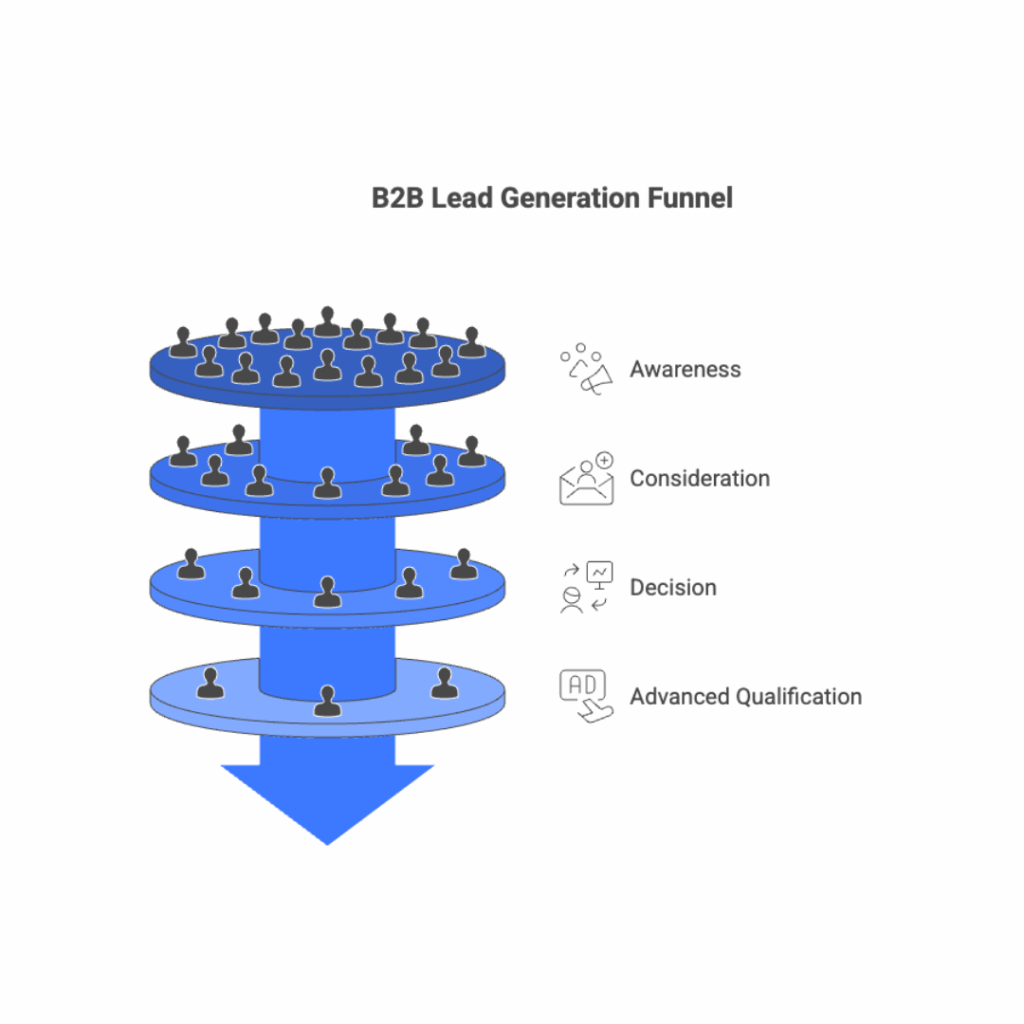
Organizations commonly distinguish marketing-qualified, sales-qualified, highly qualified, or BANT-qualified leads. The labels are not interchangeable standards. Each requires a documented definition appropriate to the process and a record of the evidence actually captured.
A BANT conversation may discuss budget, authority, need, and timing, but incomplete answers should remain incomplete rather than being filled with assumptions. Sales acceptance should mean the receiving team can use the record under the agreed criteria.
An opportunity is a separate commercial record with its own entry criteria and owner. A booked meeting is not an attended meeting, and an opportunity amount is not closed revenue. Preserve those distinctions when reviewing performance.
Build a simple operating process
- Define the audience: supported organizations, relevant roles, geography, and exclusions.
- Choose the offer: a useful answer, resource, event, or conversation suited to the buyer task.
- Plan appropriate reach: select channels and review eligibility and communication requirements.
- Test the response path: check forms, resource access, confirmation, routing, and source capture.
- Validate and qualify: distinguish accurate records from evidence of an applicable business requirement.
- Deliver context: preserve the request, source, relevant notes, preferences, owner, and next action.
- Review outcomes: use acceptance and rejection reasons to improve the process.
Keep the CRM coherent
Use stable identifiers, stage history, and explicit matching rules. A repeat request should not automatically create a new person or restart an inappropriate sequence. Existing customer and account ownership information should remain visible.
HubSpot's record deduplication documentation provides an implementation example of matching behavior. Check the actual CRM and integration settings before assuming duplicate handling is consistent across forms, imports, and automated systems.
Measure the result the process is meant to create
Report valid requests, accepted leads, attended conversations, opportunity progression, and closed outcomes separately. Define denominators, dates, cost basis, and attribution. Recent acquisition cohorts may need more time to reach later stages.
A growing database can coexist with poor fit. A lower form-fill cost can coexist with higher sales effort. Read the underlying reasons before deciding which channel or asset to expand.
How Qualent Media fits the process
Qualent Media's B2B lead generation service describes audience selection, engagement, qualification, and contextual delivery. Its published cases provide company-reported examples of specific campaign formats and outcomes. Those engagements illustrate the process without guaranteeing another business the same result.
For implementation, continue with the follow-up guide or the KPI definition guide. Agree the useful next action before treating an address as demand.

Asim Siddiqui
Asim Siddiqui oversees operations at Qualent Media and writes about B2B marketing, campaign execution and sales-ready lead processes. About Asim and his work