
Updated October 31, 2026 for US B2B teams.
Lead generation for a recruitment agency means finding employers with a hiring requirement the agency is qualified to serve. It is different from attracting candidates. The commercial objective is an appropriate client conversation about a real role, specialty, or hiring problem—not a larger database of unrelated contacts.
Make the agency's specialty specific enough to evaluate
Define the roles, seniority, employment model, industries, and territories you can support. Clarify whether the agency provides permanent placement, temporary staffing, retained search, or another service. An employer should be able to recognize what you do without reading a vague claim about end-to-end talent solutions.
Use only experience and delivery capabilities the business can substantiate. Do not invent candidate availability, a completed placement, a client logo, or a time-to-fill result. If a case is confidential, use an approved description that preserves the evidence without exposing private information.
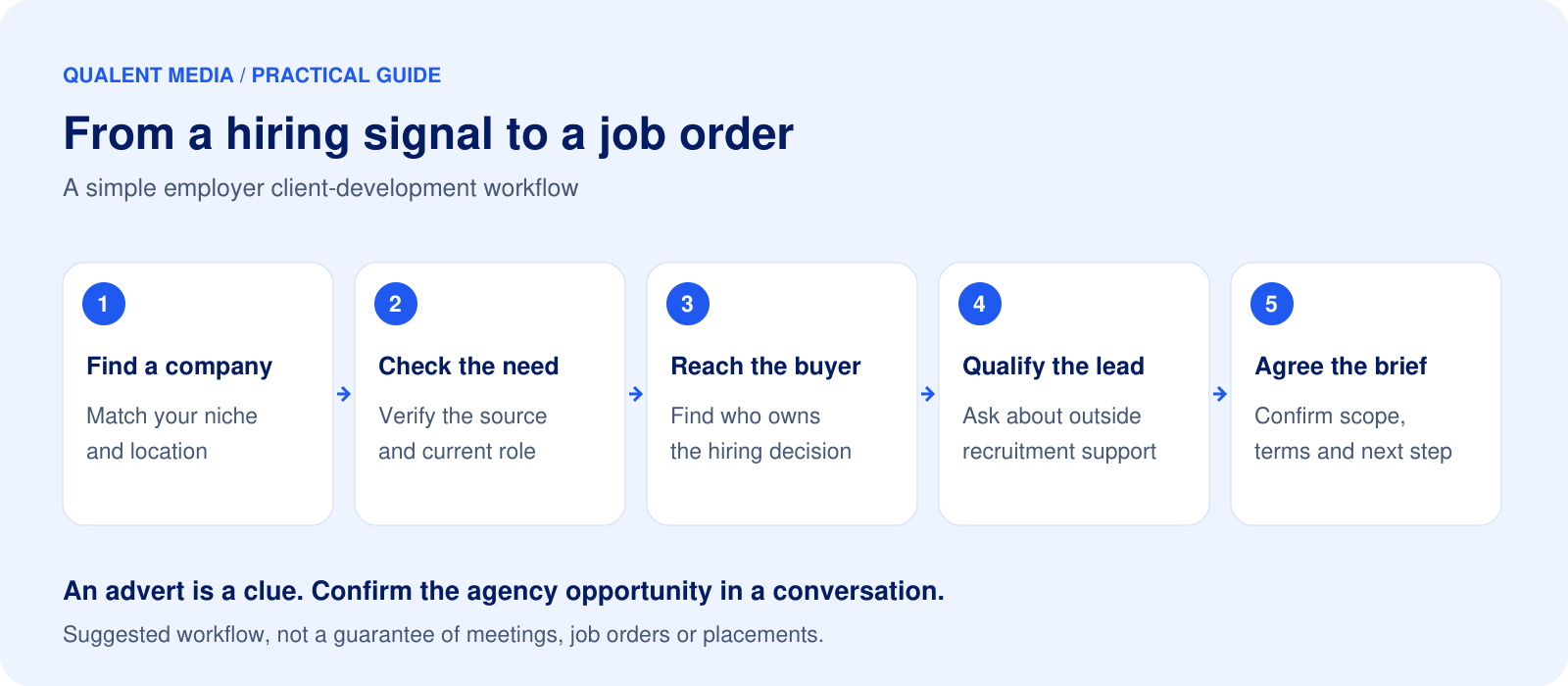
Treat hiring signals as a research prompt
A live job posting is evidence that a role was advertised. It does not prove that the employer uses agencies, has an approved external recruitment budget, or wants unsolicited candidate profiles. Check the original employer page, opening date, location, and any agency instructions.
Build an account record with the public source, relevant specialty, known relationship, and a question worth asking. Expansion news or a new office may be useful context, but do not convert it into a claim about private hiring plans.

Contact the appropriate business owner
Identify whether the relevant route is talent acquisition, HR, procurement, a hiring manager, or an approved supplier process. Respect instructions about submissions and candidate ownership. Sending a résumé to the wrong person can create confusion and expose information unnecessarily.
“Hi [name], I saw [verified role or hiring announcement] on [original source]. Our agency focuses on [accurate specialty and territory]. Do you use external recruitment support for this type of requirement, or is there an approved supplier route we should follow?”
This is a template to adapt with verified facts. It does not claim a relationship, an available candidate, or a successful campaign. Include appropriate business identification and communication preferences, and stop when the recipient objects.
Qualify the assignment before promising delivery
| Question | What it resolves | Record to preserve |
|---|---|---|
| What work must the hire perform? | Actual role requirements rather than a generic title | Agreed brief and essential criteria |
| Who owns the hiring decision? | Stakeholders and communication route | Named business owner and process |
| What is the approved engagement model? | Whether the agency can participate | Supplier requirements and commercial next step |
| What constraints affect delivery? | Location, eligibility, compensation and timing | Confirmed constraints and unresolved questions |
Keep employer qualification separate from candidate assessment. Do not treat a prospect's willingness to speak as an authorized search assignment. Agree the scope and commercial process through the appropriate business channels.
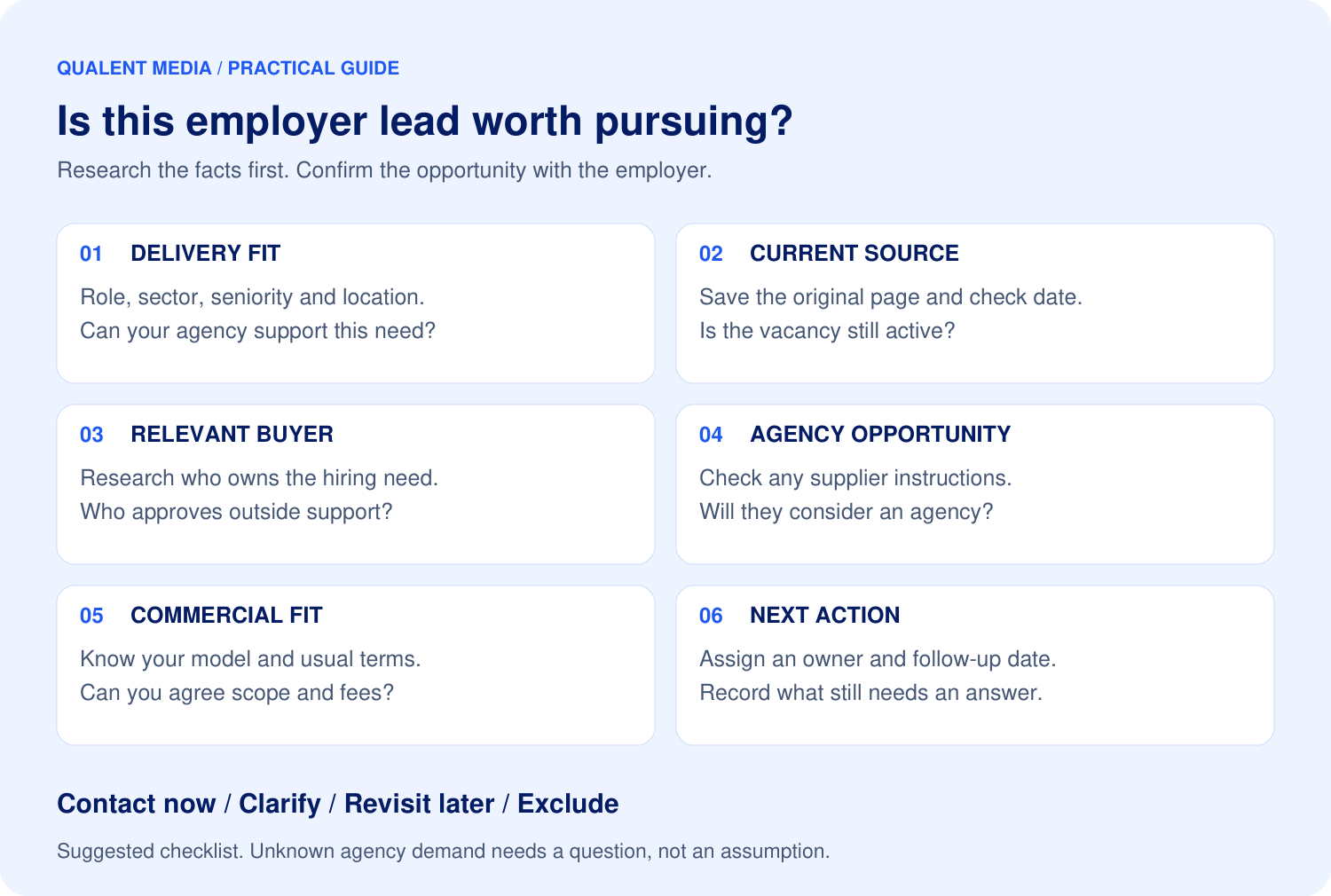
Publish information that helps employers choose
Useful agency content explains how an engagement works: brief intake, sourcing boundaries, screening responsibilities, candidate presentation, interview coordination, and replacement or follow-up terms where applicable. Show the questions an employer should resolve before starting.
Distinguish original research from a recruiter observation. If presenting compensation or labor-market figures, use a current attributable source with geography, role, period, and methodology. Do not create a salary benchmark from a handful of unrepresentative conversations.
Track client development without mixing in candidate volume
Measure relevant employer conversations, qualified assignments, signed engagements, and completed placements using defined stages. Track rejection and no-fit reasons. A large candidate pool is a delivery input, not proof that the agency acquired suitable clients.
Apply communication and suppression controls to outreach. Google's sender guidance is relevant to technical email requirements for personal Gmail destinations, while the agency must separately review whether the message and contact use are appropriate.
Qualent Media's B2B lead generation service can be discussed around employer targeting, relevant outreach, qualification, and sales context. The agency should retain responsibility for substantiating its recruitment capabilities and defining an assignment it can fulfill.

Asim Siddiqui oversees operations at Qualent Media and writes about B2B marketing, campaign execution and sales-ready lead processes. About Asim and his work
Asim Siddiqui oversees operations at Qualent Media and writes about B2B marketing, campaign execution and sales-ready lead processes. About Asim and his work